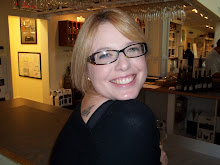
The chronicled witticisms, gaffes, and other such laughs of an aspiring writer.

18 October 2010

Lipstick and envy add color to my sister's bridal shower

Southern bridal showers are community convergences filled with finger-food buffet lines and pre-marriage gift-giveaways. These pre-nup parties are as customary as a Southern woman’s relationship with her lipstick.

I recall my earliest memories of Granny Virgie, slightly parting her thin lips for a tube of fuchsia lipstick. Once administering the coral color onto her made-up mouth, she’d pucker a pose for a palm-sized mirror.

Granny Virgie could apply her lipstick while driving a car, praying on a church pew, or chomping on hog jowls during dinner table discussion. And she still can.

So last Sunday, while Mama and I prepared for baby sister Audrey’s bridal shower, I wasn’t surprised by her Southern, motherly lecture.

“Where’s your lipstick?” she asked, as my knobby knees dangled over the beige-carpeted stage in the Liberty Christian Church fellowship hall in Epsom.

“I’m wearing it,” I groaned, bracing for the all-too-familiar approaching battle.

“Well, it’s not dark enough,” she complained. “You’re lips are too pale.”

“It’s the only lipstick I’ve got,” I grumbled, while Mama pulled forth a tube from her purse.

“Much better,” she sighed, as I slid the slick lipstick across my no-longer pale, pouting mouth. “Why, it looks better on you than it does on me,” she consoled as we waited for our kinfolk to arrive.

I’d never hosted a bridal shower before. And understandably. Until Audrey’s engagement, most neighbors assumed my parents had raised three spinster daughters, who’d wrinkle alone as time withered away. Yet, against all odds, I was throwing an engagement event with my 37-year-old spinster sister, Wendy.

Aware that Mama was distressed that her daughters were directing the big day, Wendy and I prepared our bridal shower “to do” list with paranoid precision, fearing the fallout of forgetting necessary nuances.

“I keep having nightmares that we’re going to run out of food!” Mama complained.

“Everyone on the guest list isn’t going to show up,” I argued with Mama, who was in a mad dash to the grocery store for more mints and bottles of ginger ale.

As 2 p.m. arrived, the tables were clothed in lace, tropical-colored corsages were pinned on the bridal party, silver ribbons were wrapped on outside posts, and guests began gathering with gifts.

“Justin, don’t open the presents so fast!” baby sister Audrey said to future brother-in-law, Justin, as gleaming, he ripped wrapping paper from each gift..

“Maybe I’ll get married just for the presents,” I told spinster sister Wendy, whose duty was to arrange the unwrapped gifts on a nearby display table.

While Wendy hustled to keep pace with “brotherhood’s” present-unwrapping, I commenced to my self-appointed duty of greeting (and entertaining) guests.

Yet, our “Mary and Martha” enactment came to a grinding halt when midway through the Eaves’ event, Daddy dazzled the soon-to-be newlyweds with a rather big box.

Justin beamed as he beheld the 37-inch flat screen engagement gift going home with him that afternoon.

Meanwhile, Wendy and I, soured by shock, disapprovingly shook our heads.

“She’s so the baby,” spinster sister Wendy said of engaged sister, Audrey.

“She’s so spoiled,” I replied, craving a chocolate ball and Pat McGhee’s pepper jelly on the nearby refreshment table.

Nabbing a napkin after my fourth feeding, I wiped my crumb-coated lips with the pastel party napkin — now stained by coral-colored lipstick streaks.

“Try this,” my spinster sister said, retrieving a tube of plum lip color from her purse.

“Why, it looks better on you than it does on me,” she said, while I checked my painted lips with her palm-sized mirror.

“Well, you better keep that lipstick handy,” I replied. And while Audrey and Justin smiled, standing by Daddy and their 37-inch flat screen TV, I resorted to the refreshment table for my fifth, but not final, feeding at perhaps the first, but not last, Eaves’ bridal shower at Liberty Christian Church.


Read more: The Daily Dispatch - Lipstick and envy add color to my sister’s bridal shower

Farm Aid's 25th installment: an experience of a lifetime

On Oct. 2, I experienced the musical highlight of my 30-year life.

“Let’s go!” I signaled to my best friend Kris, as we slammed shut the hatch to my Ford Escape early on the morning of Oct. 1.

Rummaging through the cloth travel sack I’d slung onto my lap, I made a final ticket check. And after securing two stubs from the bottom of the bag, I read their inscription to my traveling cohort — “Farm Aid 25: Growing Hope for America. Miller Park, Milwaukee, WI.”

When Willie Nelson, John Mellencamp and Neil Young organized the first Farm Aid concert back in the fall of 1985, Kris and I were five-year-old schoolmates, sporting Stride-Rite sneakers and making mud pies in my sand-paved driveway. We knew nothing of the family farm crisis facing our country.

Now, 25 years later, we’ve shed our child-sized Stride-Rite shoes for size 8 1/2 boots. And that morning, while my Honeysuckle Rose CD played its trademark track, “On the Road Again,” we scooted out of that same sand-paved driveway, northbound for Farm Aid’s silver anniversary concert.

With local farm land falling to residential developments these days, not only transforming Epsom’s landscape but that of other farming communities, the Farm Aid movement has become perhaps my most championed cause.

And yet, despite more than two decades of Farm Aid action, many are unaware of the organization’s work.

While this year’s quarter-century celebration corralled thousands of concertgoers into Milwaukee’s Miller Park stadium, its musicians and iconic red-bandana wearing president, Willie Nelson, are mere frontmen for the non-profit organization.

Farm Aid’s mission is to keep family farmers on their land. And since its inception, Farm Aid has raised more than $37 million to stop farm foreclosures, aid farm families in crisis, and address farm policy. Farm Aid protests factory farms and educates farmers and consumers on issues such as genetically modified food and growth hormones.

After arriving in Milwaukee, Kris and I joined other Farm Aid members for a pre-concert march in the downtown district. Overall-clad farmers and friends waved pro-family farmer banners and “Stop Factory Farm” signs, while a crew of two-legged dairy “cows” kept pace with the pack. The march culminated at Pabst Theater for a Farm Aid-eve concert.

The following day, a cool north wind woke the city of Milwaukee with a 20-degree drop in temperature. And so we Southern gals wrapped ourselves in sweatshirts, sweaters and toboggans for our first frigid Farm Aid concert. Once inside Miller Park’s gates, we combated the cold with hot apple cider, fried cheese curds and barbecue pork chop sandwiches – all sold at food stands throughout the stadium featuring locally grown food. After this noon-time snack, we returned for more local food stand treats — doughnuts, corn dogs, and sugar-powdered funnel cakes. And of course, more apple cider.

By snack stop number three, we were primed for the 7 p.m. Farm Aid board of directors line-up of Dave Matthews, John Mellencamp, Neil Young and Willie Nelson.

Nelson’s son, Lukas, joined this year’s concert, performing a Jimi Hendrix electric guitar piece with his teeth. And Aerosmith’s Steven Tyler made a surprise appearance, opening Nelson’s set with their previously recorded duet, “Once is Enough.”

“We’ve been so excited about this concert,” Wisconsin organic dairy farmers Brian and Katy Drews said, while standing beside me in a concession stand line. “This is our first overnight trip in 12 years.”

“12 years!” I cried to the young couple, who turned to one another and smiled.

“Somebody has to milk the cows,” they replied.

Willie Nelson says family farmers like the Drews are our nation’s unsung heroes. And at that moment, I realized that despite the day’s musical marvels, the Drews were the true show stoppers at Farm Aid 25.


Read more: The Daily Dispatch - Farm Aid’s 25th installment an experience of a lifetime

06 October 2010

Making my peace with pickled eggs and beets

Last week, I pickled my first batch of eggs and beets.

My first encounter with this pickled pair occurred a decade ago, while on a date. I remember watching my former fella twist open the lid of a quart-sized glass jar, uncovering a plenty of purple eggs floating in sweet beet juice. And then, he reached his bare hand into the bobbing bounty, and in one swoosh, snagged and swallowed one of those slick eggs. A true glutton, he reveled in his repetitious “grab and gobble” until all that remained in the pickling jar was juice.

Aghast, I feared the fallout of his feast and was overcome by pickle-juice induced jitters. And sure enough, an “eggs”plosion occurred.

“Good grief!” I hollered out in the middle of Walmart, as I escaped down aisle seven, leaving my beau behind.

The evening ended soon thereafter.

And so began my aversion for pickled eggs and beets.

That is, until last week, when I faced my foe with friends John and Bev Lazar.

Pennsylvania born and bred, John and Bev were beckoned South several years back — John’s career the catalyst. Now retired, John spends his time tending to post-career projects, such as his backyard biddies and their newly constructed coup. While Bev leaves the feathered flock for John, she shares his pickling passion for eggs and beets, as was discussed during a recent visit at the Lazar homestead.

“I’ll teach you how to make ‘em,” John jabbed, following my tale of terror from 10 years back.

And so, a pickling date was set, with the promise that Bev would cook a pre-pickling dinner.

I arrived at the Lazars’ kitchen table with an unusually empty stomach that night. And after two servings of ham loaf, baked beans and macaroni casserole, Bev brought forth a golden-brown delight.

“I know you’re too full for this now,” she smiled, slicing a piece of homemade pumpkin pie. “We’ll wait until your food’s had time to settle.”

“No, I’m not!” I cried, evoking the spirit of my Granny Virgie as I unlaced the drawstring waistline of my brown bohemian dress.

And so I ate pumpkin pie, while John pulled the pickling ingredients from the refrigerator.

Bev unsnapped a Tupperware container bearing 18 boiled eggs, which emitted an odor that immediately transported me to my decade-ago date night on aisle seven at the Walmart.

Beets were soon boiled while sugar and spices were scooped atop them. While the stove top steamed with the pickling portion of the recipe, we stood around the kitchen counter and waited. And ate more pumpkin pie.

“Once the eggs pickle, they’ll turn purple down to the yolk,” Bev explained, while I spooned another piece of pumpkin pie into my mouth.

Time passed, and the sweet beet concoction soon cooled. And, after layering both eggs and beets in an enormous Vlasic pickle jar, we said our goodbyes. Those eggs had to set and soak.

And for five days, they did.

Admittedly, I’ve never been a fan of boiled eggs or beets. Yet, I pulled forth one of each for my first try of the pickled treat. And low and behold, I liked them. Hence, I had a second serving of those sweet eggs and beets. As did little Isabella Lazar, who helped herself to a handful that same night while seated at her grandparents’ kitchen table.

Now, I know what you’re wondering. And I readily report that while my beau from back yonder had a fallout from his feast, I suffered no such rupture from my batch of pickled eggs and beets.

Which leads me to wonder ... was he full of something else, other than pickled eggs and beets?

Gina Eaves is an Epsom native, a Peace College graduate and an advertising representative at The Daily Dispatch. E-mail her at geaves@hendersondispatch.com.

***********************

Pickled eggs and beets

Ingredients:

1 can sliced beets

1/4 cup sugar

1/3 cup vinegar

1/2 tsp cinnamon

1/4 tsp salt

4 - 5 boiled eggs, peeled

Combine beets (and juice), sugar, vinegar, cinnamon and salt in pot. Bring to a boil, then simmer for 5 minutes. Once cooled, layer beets and eggs in jar and refrigerate.

Eggs should set for a few days before served. Enjoy!


Read more:
The Daily Dispatch - Making my peace with pickled eggs and beets

On the road to somewhere out in the middle of nowhere

Note: This week’s column necessitates a disclaimer. As a church-reared child, I was warned against running off with another woman’s husband. The pastor preached this pew-squirming sermon during several Sunday morning worship services. Just so you know, I had his wife’s permission. With that said, here’s my tale of me and Merle.


I was “wheeling and dealing” the day I met Merle. In fact, I was in mid-sales pitch when Merle’s motorcycle pulled into the graveled parking space outside of my Dispatch cubicle window. Springing from my seat, I motioned to the motorcycle while mouthing to my newfound friend, “I want to ride that thing!” Minutes later, following a spontaneous “I’ll call you right back” to the caller on the other end of my phone line, I joined Merle and my co-worker, his wife, by Merle’s Harley.

“Go for a spin,” my co-worker laughed while I mounted Merle’s motorcycle for the first of many whirls around town. Helmet latched and eyes shut tight, I screamed as we scooted down Chestnut Street that autumn afternoon. Yet, somewhere along N.C. 39, my shrieking ceased. And while Merle’s motorcycle steered my work stress away, I had to agree with John Denver that “sunshine on my shoulders” made me happy, too.

Nearly two years later, and I assure you with his wife’s blessing, we embarked on a day-long motorcycle mountain trip. Me and Merle.

Merle mapped our trek into the Virginia mountains, deliberately dodging highways for rural roads — few marked with yellow-painted lines. And only hours into our journey, we’d crossed into rural territory that made Epsom seem city-like.

That’s when we wayfarers came to a stop sign, where some serious head scratching started.

“Do you see 639 anywhere on this map?” Merle asked, while he and I scanned his N.C. state road map for the lone road that stretched before us.

Nodding my noggin “no,” I stared straight ahead at the wooded wilderness, and then looked both “left” and “right” at our only onward options, save the unthinkable act of turning back.

Now, I’ve seen similar situations in movies — two stranded souls in search of an oasis, while desert sands stretch as far as the eye can see. That’s about how we felt that Friday. Me and Merle.

And akin to those motion pictures, a marvel manifested itself that morning.

From afar, I heard a buzz. And then a putter, putter, putter.

The buzz … putter, putter, putter persisted until, against all odds, a banana-yellow moped turned the bend of that remote road.

“We’re saved!” I cheered, while a map-waving Merle hustled towards the bumble bee bike that buzzed with a putter, putter, putter towards us.

I’m not sure which of us understood our unfortunate fate first. Perhaps it was me, standing spectator to Merle as he beckoned the elderly driver atop that yellow moped. Or maybe it was Merle, whose road-side assistance request was rejected as the old man “made tracks,” never stopping for us two baffled bikers.

Buzz … putter, putter, putter … crept the little yellow moped, as it disappeared down the trail we’d just traveled.

And with arms still suspended as distress signals, there we stood. Me and Merle.

All roads lead to somewhere, even if they’re out in the middle of nowhere. And so together, we found our route that day — from Alta Vista to Smith Mountain Lake — and from Smith Mountain Lake to Mabry Mill — and from Mabry Mill to the Blue Ridge Parkway. Me and Merle.

Motorcycle riding’s a risk, no doubt. But the experience it grants is a gift, indeed. And so I breathed in the crisp mountain wind that whipped my face, while on two wheels I rode 400 miles of Virginia countryside with my biker-bound comrade. As all adventures begin, they too must end. And as sunset hung its head over South Boston, we savored those last miles of serenity, found in the revving roar of that Harley’s engine.

Me and Merle.


Read more: The Daily Dispatch - On the road to somewhere in the middle of nowhere

20 September 2010

College debt delivered me back to my parents' doorstep

My name is Gina Eaves. I’m 30 years old. And I’m broke.

I didn’t deliberately succumb to my self-defined debt status. On the contrary, my post-high school path resembles that of many young adults. I pursued a higher-education route, in my case via two North Carolina colleges. Although I took a mid-college hiatus, forsaking text books and lectures for overseas travels “to discover myself” (or so I told my parents), I finally completed college. And while my job journey took a few twists and turns, I eventually acquired my current post at The Daily Dispatch.

Yet two years later, and similar to most 20- and 30—something-year-old professionals, I repeat: I am broke.

I earned a four- (well, technically five-) year degree. And by the grace of God and my supervisors, I’ve maintained my career. So why is that, despite these apparent achievements, I have no money?

Because like most college graduates, I’m in debt. Namely credit card and student loan debt.

A decade after leaving Epsom for college, this academic debt delivered me back to my parents’ doorstep. Admittedly, living at home with my middle-aged parents and 17-year-old senile cat, Sassy, isn’t where I expected to be at this point in my life. Yet, like most graduates in my post-college debt dilemma, there seems to be no end to the monthly reminder that education not only pays off, it requires payment.

Compared to most debt-ridden Americans, I suppose I’m a little-leaguer in the game of borrow and pay. Let’s face it – I have no mortgage. But only because I can’t afford a mortgage. Or rent for that matter. Not unless I’m willing to dig for dimes beneath couch cushions to buy such nutritional groceries as Vienna sausages and beans and franks.

So how does someone in my cash-strapped situation trade debt for financial freedom?

Enter my friend and Franklin County native Clarky Davis, The Debt Diva.

Davis is a debt management expert for CareOne Debt Relief Services. With more than 10 years of personal and professional experience, she offers financial fitness education and “real world” money-saving tips to help consumers trim their spending in just about every area of their lives.

After discussing my debt dilemma with Davis, I’m confident that a parent-free home is in my future. But like any achievement, there are steps to reaching that tin-roof house in the fields. Aware that most folks financially falter from time to time, I’ve included The Debt Diva’s money-management strategies. Although geared to my situation, the steps below can benefit anyone seeking a specific financial goal.

1) Get a plan. Know what you want to accomplish, set a date, and implement a strategy for that goal.

2) Get engaged with your current spending. Once you’ve paid your bills, where’s the rest of your money going? Are your spending habits helping you meet your goal?

3) Can you accomplish your goal with the budget you have? Ask yourself if accomplishing your goal is important enough to make a change. You can’t complain if you’re not willing to make a change. Sometimes you have to make uncomfortable changes to meet your goals. This could very well mean a second job. Remember, just because you need a second job now doesn’t mean you’ll need it forever. Understand your financial situation is going to change.

4) Consistency is key. Make all payments on time, each and every month. And monitor your ratio of credit to debt. Creditors monitor these two factors more than any other.

5) Save. Start moving money into a savings account! Build up your savings account before paying off the mortgage (or car) early. Both of these can be repossessed — but your savings account can’t!

6) Team up with someone who’s in the same cash-strapped situation. Share your experiences as you commit to living similar frugal lifestyles.

7) Stay focused on the positive! Check every month to watch your debt go down and your savings go up. Be your own cheerleader, and remember – you won’t be broke forever.


Read more:
The Daily Dispatch - College debt delivers me back to my parents’ doorstep

13 September 2010

Cat Stevens versus Dr. Mike's atomic bread

While most folks flocked to the beach Labor Day weekend, my best friend Kris and I chose another, more winding route.

“This album’s appropriate,” I laughed, while my Cat Stevens’ CD blinked “Track 6” in our Ford F-150.

“Miles from nowhere,
I guess I’ll take my time,
Oh yeah, to reach there.


Look up at the mountain,
I have to climb,
Oh yeah, to reach there.”

Bidding the flatlands farewell, we rolled down our Ford’s windows and breathed in the freedom known only to those 30-year-olds fleeing their parents for the weekend. And with radio roaring, we sang along with Cat Stevens.

“I creep through the valleys,
And I grope through the woods,
‘Cause I know when I find it my honey,
It’s gonna make me feel good.”

And as we belted the nature-loving lyrics of the popular 70’s musician, we indeed felt good.

Several album tracks later, we pulled onto a Statesville exit ramp to fuel up on gasoline and Starbuck’s coffee. Two cups of Grande Skinny Vanilla Latte’s later, the Blue Ridge mountains peaked above I-40’s horizon. Our truck twisted among the coiled western Carolina roadways and eventually parallel parked in historic downtown Saluda.

“Doctor Mike!” Kris and I cheered to our mountain friend, after bumping our way through the crowded Purple Onion, a Saluda favorite, popular for its organic menu and Friday evening entertainment.

The pluck and bow of an electric fiddle roused the locals while we chatted over our meal.

That’s when Dr. Mike mentioned his gift.

“I made you some bread,” he smiled, while I savored a rainbow medley of peppers that dangled over a forkful of orzo.

“Fantastic!” Kris and I cheered, clinking our glasses of Malbec wine in appreciation.

“Oh, and about the bread …” Dr. Mike hesitated as he handed over the heavy loaf. “Some folks say it’s atomic,” he cackled.

“What do you think Dr. Mike meant by atomic?” I asked Kris later that evening, as we drove to our weekend mountain house.

“I’m really not sure,” she replied, as the truck turned toward Etowah. “But I bet we’re going to find out!”

Pajama-clad and curious, Kris and I settled onto a sofa with two slices of Dr. Mike’s bread. And with a few chomps of the homemade loaf, we understood why the bread was defined atomic.

“This is pure fiber!” I cried, as Dr. Mike’s chuckles echoed in my mind.

And then we both shared an expletive, all too familiar with the ramifications that awaited us come digestion.

The next day, Kris and I journeyed the Blue Ridge Parkway for a morning hike up Mount Pisgah. After ascending its peak and beholding the majestic mountain view, we awarded ourselves two apples and a brief respite before our descent.

And then, it hit. Dr. Mike’s bread, that is.

“It’s time to get down this mountain!” I hollered, accompanied by Kris’ likewise atomic shock.

Our mountainous descent was a series of skids and falls, bypassing other hikers as we hurled ourselves in a fast and furious fashion downward. The never-ending stick and stone trail was a miserable reminder of Cat Stevens’ lyrics:

“Miles from nowhere,
I guess I’ll take my time,
Oh yeah, to reach there.”

I’m not sure how we made it down Mount Pisgah that afternoon, or to the Pisgah National Forest’s public restrooms for that matter. But by the grace of God, we did. And although I was thankful for a mountain weekend “miles from nowhere,” Dr. Mike’s bread reminded me that sometimes it’s good to get back to modern conveniences as well.

Or at least indoor plumbing.

The printed page still holds its own charms

Digital dictionaries may soon replace their print predecessors — or so it seems after last week, when Oxford University Press announced a potential switch to an online-only version of the Oxford English Dictionary’s upcoming third edition, ending the 126-year-old print publication.

“The print dictionary market is just disappearing,” reported Nigel Portwood, chief executive of Oxford University Press, in The Sunday Times. “It is falling away by tens of percent a year.”

With news of the popular dictionary’s threatened press-life, I revisited the weathered pages of my own Webster’s New World Dictionary, seeking words that describe the book and its electronic replacement.

• An’-ti-quate’: (verb) to make old, out of date, or obsolete; (adjective) an’-ti-quat’-ed. Some would contend that today’s online dictionaries antiquate the hard-copy edition that still stands ready on my office cubicle shelf.

Likewise, today’s high school students would consider my high school homework sessions antiquated — flipping through the pages of my paperback dictionary while typing term papers on a blue-screened word processor.

These digital days, online dictionaries offer immediate gratification for those word-struggling students who, like me, wait only hours before a deadline to finish a report — or a column.

• Im-me-di-ate: (adjective) without delay; instant. Our growing tech-savvy population seeks the convenience of instant search engine results from free online sources, like www.dictionary.com. With a single click of “enter,” a list of definitions, word origins and history, and even famous quotations appear on a computer screen that only seconds earlier was blank, save a sundry of Internet advertisements. No time-consuming turning of pages to search for sought-after word meanings. And no aroma of ink.

• aroma: (noun) a pleasant odor; fragrance. Although I reference online sources while writing, I likewise thumb through my dictionary, sometimes dealing the pages as a poker hand just to get a whiff of the ink. As peculiar as this practice seems, I savor the smell of ink. Besides, a scratch-and-sniff session with my computer screen would appear more eccentric — and wouldn’t grant the same olfactory satisfaction derived from my book’s printed pages.

Despite this joy, some environmentalists would argue I consider Mother Earth over my ink-smell fixation. These conservationists, sometimes called tree huggers, would ask that I forsake my fondness for print dictionaries to save ... well, the trees.

• con-ser-va-tion: (noun) conserving; the official care or management of natural resources. I’ve been told the Internet can decrease the amount of paper used for books, manuals, charts and other work-related products. With computer software systems replacing “out-dated” corporate procedures, as well as human bodies, I have observed the efficiency of such idealism — most notably in the overflowing trash stash and recycling piles by office printers. But, let’s face it. We’re a work-force and world that’s increasingly dependent on digital.

• de-pend’-ent: (adjective) determined by something else; relying (on) for support, etc. A few days ago, I reached for a calculator to compute a work equation. Midway through entering the data, I stopped. “You don’t need a calculator!” I fussed at myself, as I mentally solved the mathematical equation.

Aside from minimal mathematical calculations, there are few work functions I perform without Internet and software programs. Production halts when power outages strike or our system server fails. At the mercy of power and IT companies, my colleagues and I wait ... and wait ... until the hums and beeps of technology jolt us back into production mode.

Due to such inevitable, albeit temporary, Internet glitches, I’ll hold onto my hard-copy dictionary. I’m certain some folks consider it antiquated, as they seek immediate results from its online counterpart. But I’ll gladly relinquish my dictionary.com dependency for my dog-eared high school dictionary.

If for no other reason, I like the way it smells.